
BIO 2026 Debrief: Why Privacy-First, Domain-Specific AI Is Gaining Traction
BIO 2026 in San Diego brought together a diverse cross-section of global biotechnology, pharmaceutical research, manufacturing and clinical organizations, providing a valuable snapshot of how artificial intelligence is being evaluated and adopted across the drug discovery landscape. Across four days of meetings and discussions, one message became increasingly clear: the conversation has shifted beyond whether AI merely has a role in drug discovery to how it can best deliver measurable scientific and commercial value while respecting the realities of proprietary data, intellectual property and client confidentiality.
Qubigen met with a wide range of potential clients at BIO 2026, holding over 100 conversations across the course of the conference. The strongest interest came from preclinical CROs and CDMOs, particularly around Qubigen's privacy-preserving, tailored AI models. Several discussions have now progressed to active scoping. A consistent theme emerged throughout the week: successful AI for drug discovery must be domain-specific, privacy-preserving and deployed in a way that enables organizations to retain full control of their data and intellectual property.
Several consistent themes emerged:
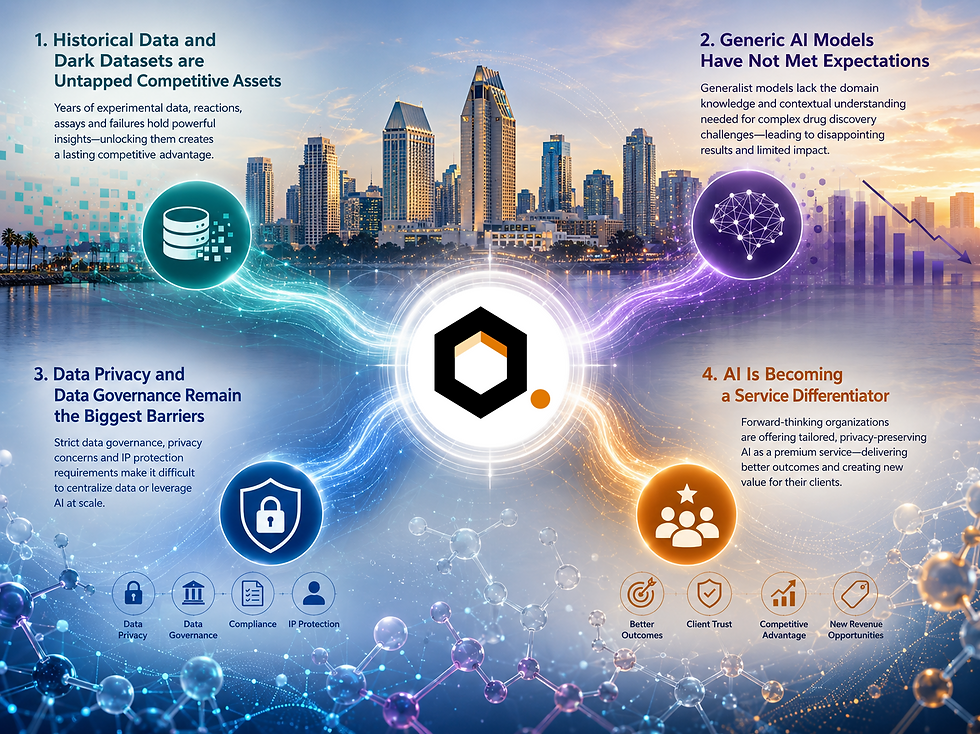
Historical Data and Dark Datasets are Untapped Competitive Assets
Many organizations possess years, potentially decades, of historical reaction data, ADMET studies, assay results, synthesis outcomes and failed experiments (dark data) that remains underutilized. These datasets represent enormous scientific investment and institutional value, yet are often fragmented across multiple systems, poorly structured, or inaccessible to conventional tools. This historical knowledge could be a significant competitive advantage to the custodian organizations if effectively harnessed, but extracting meaningful insights remains challenging. This is precisely where Qubigen's purpose-built AI models deliver value, enabling organizations to unlock intelligence from their historical data, while keeping that data under their full control.
Generic AI Models Have Not Met Expectations
Many groups related stories of adopting generic AI platforms that showed early promise, but failed to deliver meaningful improvements in medicinal chemistry, SAR analysis, reaction prediction or molecular optimization when applied to real-world discovery programs. Practical, accurate AI models must be built for specific scientific domains and trained on the organization's own proprietary data. Qubigen develops tailored, project-specific AI models that generate accurate, actionable insights from each client's unique data.
Data Privacy and Data Governance Remain the Biggest Barriers
For many organizations that operate across multiple sites, subsidiaries or partners, data privacy and security continue to be the biggest obstacles to AI adoption. This is especially pronounced among larger organizations with strict compliance requirements and heavy governance frameworks. Qubigen’s ability to train and deploy AI models without moving, centralizing or exposing client data consistently resonated throughout BIO.
AI Is Becoming a Service Differentiator
Many organizations and laboratories are now thinking about AI as a commercial offering. Rather than using AI purely as an internal productivity tool, there is clear interest in providing AI-powered results as a premium, client-facing feature, whilst still preserving data isolation and ownership. Qubigen’s approach allows these organizations to leverage their scientific expertise, together with their accumulated proprietary data, to create differentiated, client specific, revenue-generating AI services.
Looking Ahead
Organizations have moved beyond asking whether they should adopt AI and are now focused on how to deploy it effectively to generate measurable value. BIO 2026 reinforced our understanding that organizations recognize the value of domain-specific, privacy preserving AI trained on their own proprietary scientific knowledge, that integrates naturally into existing discovery workflows.
For Qubigen, the conversations in San Diego validated the direction we have been pursuing from the beginning: enabling organizations to build secure, tailored AI systems that learn from their unique data while keeping that data under their control.
We would like to thank everyone who met with us during BIO 2026. The discussions were insightful, the interest was encouraging, and we're looking forward to continuing many of these conversations as pilot projects move into the next stage.
Qubigen - Accelerate Drug Design Without Exposing Secrets
Qubigen builds and hosts powerful, privacy-preserving AI Engines, turning discrete client-specific data into a competitive edge. Whether you're advancing active programs, reviving dormant data, or starting from scratch, Qubigen’s secure Federated AI and computational modelling and chemistry platform can help you identify, optimize, and accelerate the path to promising lead drug candidates. Get in touch to explore how we can support your next development.


